Alpaca Farms Farm visits & fresh-air days
Alpaca farms · Australia

Alpaca farms across Australia

Find alpaca farms from the New South Wales Southern Highlands to Tasmania, the Queensland hinterland and Western Australia. Browse by state and discover how alpacas became part of Australian farming.

A herd of alpacas in Australian countryside beneath eucalyptus trees with distant mountain ranges
Australian alpaca history

How alpacas came to Australia

Alpacas were first brought to Australia in the nineteenth century, when their valuable fibre caught the attention of people involved in the wool and textile trades. The first attempt did not establish a lasting industry. More than a century later, a second introduction helped alpacas become part of Australian farming.

1858

Charles Ledger's venture

Alpacas brought from South America arrived aboard the Salvadora in December. Ledger believed their fibre could have a significant agricultural future in Australia, but the early effort did not develop into an enduring industry.

1988

A new beginning in Victoria

Geoff and Nancy Halpin's Capalba Park property near Seymour received three alpacas in May. Their arrival drew media attention and is recognised by the Australian Alpaca Association as the start of the modern Australian industry.

1990

Breeders organise

The Australian Alpaca Association was established as breeders joined forces to develop standards, education and a shared future. Imports and local breeding helped expand the population beyond the first pioneering properties.

1990s

Shows, fibre and growth

Alpacas appeared more widely at agricultural shows, while breeders focused on fleece traits and herd improvement. Interest grew in the animals as livestock for fibre production as well as for their distinctive presence on farms.

Why the first effort did not last

Moving alpacas across oceans in the nineteenth century was difficult, and keeping a productive breeding population required knowledge, reliable animal care and an established market for the fibre. Ledger's vision proved much bigger than the infrastructure available to support it. The original animals did not become the foundation of Australia's present-day population.

Yet the idea itself was remarkably forward-looking. Alpaca fleece offered a natural textile quite unlike standard sheep's wool, and Australia's existing expertise in animal husbandry made the concept attractive even if its first attempt failed.

What changed a century later

Modern quarantine arrangements, international breeding relationships and a growing community of dedicated owners helped the new industry gain momentum. Farmers could exchange practical knowledge, record pedigrees and select animals for desirable fibre and conformation traits. Agricultural exhibitions gave the public opportunities to see animals that had once seemed extraordinary.

Today, some farms concentrate on breeding or fibre, while others welcome visitors for educational tours, animal encounters or farm shops. That variety is part of what makes exploring the individual Australian regions so interesting.

Historical references: Australian Museum — Charles Ledger's venture and Australian Alpaca Association — Australian alpaca chronology . Dates above reflect the modern industry beginning in 1988, distinct from the nineteenth-century introduction.

An Australian field guide

What you can expect to see on an alpaca farm

Both animals belong to the camelid family and have South American origins, but alpacas were traditionally developed primarily for fibre. Their compact size, soft fleece, expressive faces and strong herd instincts make them fascinating animals to observe on a working property.

They are livestock, not living toys. The best encounters respect their space, allow them to approach at their own pace and follow instructions from the people caring for them.

Learn more about alpacas

Herd life comes first

Alpacas are social animals and are normally kept with companions. When you visit, watch how they move, rest and communicate as a group rather than expecting each animal to seek human attention.

Grass, hay and careful feeding

Suitable pasture and forage form the foundation of an alpaca's diet, with management adjusted for climate, feed quality and individual needs. Visitors should never offer food without the farmer's permission.

What do alpacas eat?

Fleece is more than appearance

The soft coat that gives an alpaca its familiar outline is an agricultural product. Shearing, sorting and processing fibre are important parts of farm life, and some properties demonstrate these activities for visitors.

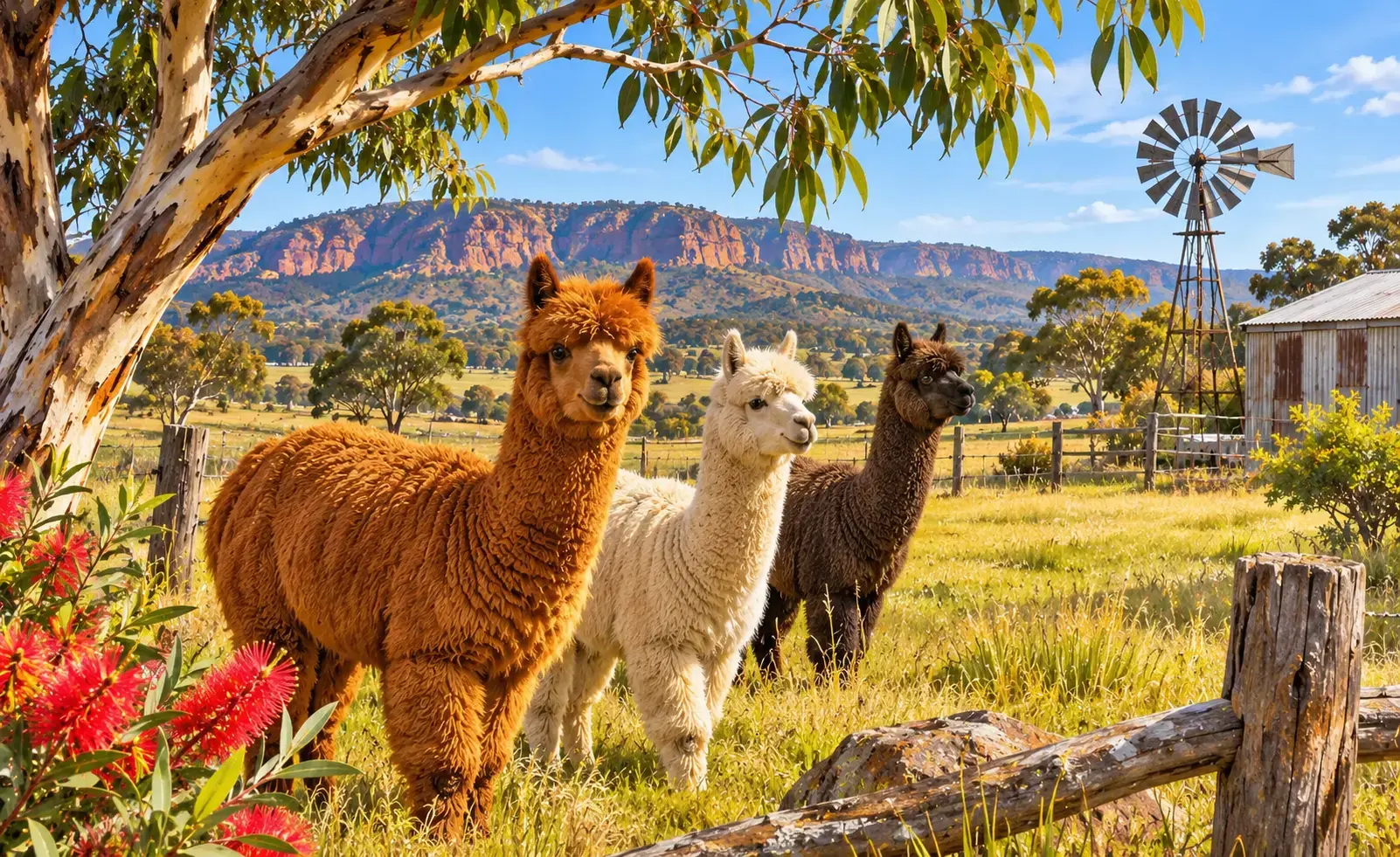
Three alpacas on an Australian outback property with eucalyptus trees, a windmill, farm shed and red rock escarpment
Climate and country

Why location matters for alpaca farming

Australia contains cool mountain districts, temperate coasts, humid subtropical areas and extensive dry inland landscapes. The fact that an alpaca farm exists somewhere in a state does not mean the conditions—or the visitor experience—will be similar throughout that state.

In cooler districts, farms may have green winter pasture and cold mornings. In hotter areas, shade, reliable water, shelter and careful management of heat become especially important. Owners also work around local pasture quality, seasonal rainfall and livestock health challenges. These practical differences help explain why farm populations and public visits are not evenly distributed.

For visitors, the lesson is simple: choose the region first, then read each property's specific arrangements. A short drive from a city can feel completely different from an extended journey into rural country.

Planning a farm visit

Before visiting an Australian alpaca farm

Public visiting arrangements vary widely. A genuine working farm may welcome scheduled groups, offer occasional open days, or be closed to casual visitors entirely.

Check the kind of experience offered

Some properties specialise in guided walks or short animal encounters. Others focus on breeding, fleece production, workshops or farm-shop products. A directory listing is a starting point, not a promise of public access. Read the farm's own information before making a trip, especially if you're hoping for a specific activity.

Book where the farm asks you to

Small farms often have limited staff and busy routines around feeding, births, shearing and animal health. Advance reservations make it possible to provide a safe and enjoyable visit without interrupting essential work. Confirm opening days and accessibility directly with the property rather than assuming rural gates are open.

Dress for an actual farm

Closed-toe shoes, sun protection, suitable layers and drinking water make sense for most rural outings. Weather can change quickly in highland districts, while summer heat is a serious consideration elsewhere. Children should follow the farmer's guidance, stay away from gates and avoid feeding or handling animals unless specifically invited.

From paddock to finished fibre

Alpaca fibre and the work behind it

For many breeders, alpacas are first and foremost fibre-producing livestock. Their fleece is prized for a combination of softness, warmth and a broad natural colour range. The final quality of any fleece depends on characteristics such as fineness, consistency, length and how well the fibre is prepared after shearing.

Shearing is an important recurring husbandry task, and harvested fibre may be skirted, sorted, washed, spun or processed through specialist mills. Some growers sell raw fleeces; others turn their crop into yarn, knitted garments and home textiles. A visit to a fibre-oriented property can reveal the considerable work between an alpaca in a paddock and a finished scarf or blanket.

Explore our alpaca clothing and fibre guides, or read more about the two alpaca types.

Huacaya

Dense, fluffy fleece grows outward from the body, producing the familiar rounded alpaca silhouette. This is the more commonly encountered type.

Suri

Longer, lustrous locks hang in a distinctive draping pattern. The fleece has a very different appearance and handling character.

Natural colours

Alpaca fleeces occur in a wide range of shades, including whites, fawns, browns, greys and black. Colour is only one consideration in fibre quality.

Real farm work

Breeding, animal health, pasture care, shearing and fibre preparation all contribute to the products people discover at farm shops and markets.

Australian alpaca questions

Questions about Australian alpaca farms.

These short answers cover the basics. For an actual outing, the specific farm's page and booking information should always take priority.

Are alpacas native to Australia?

No. Alpacas originated in the Andes of South America and have a long history of domestication there. Australia had an unsuccessful nineteenth-century introduction, followed by a modern industry that began in the late 1980s. Their presence on Australian farms today reflects generations of breeding and husbandry, not a native wild population.

Can I visit an alpaca farm without a booking?

That depends on the individual property. Some offer regular public sessions; others require appointments or do not offer visits. Check the farm's official arrangements before travelling and never assume a working property is open simply because alpacas are visible from the road.

Where can I find an alpaca farm to visit?

Start with our Australian regional directories and check which farms offer tours or animal encounters. For a day trip from Canberra, look in New South Wales.

When is a good time to visit?

There is no single national best month. Climate varies from tropical northern regions to cool southern highlands. Look at the local forecast, any seasonal activities advertised by the farm and whether a visit coincides with heat, heavy rain or livestock management work.

What's the difference between alpaca fleece and sheep's wool?

Both are useful animal fibres, but their characteristics and processing can differ. Alpaca fleece is known for softness and a wide range of natural shades, while sheep wool varies enormously by breed. Fibre diameter, preparation and the finished product matter more than broad claims that one fibre is universally better. Read our alpaca versus wool guide .

Do alpaca farms only keep alpacas?

Not always. Many Australian rural properties manage multiple types of livestock or agricultural activities. Some alpaca farms also offer farm shops, gardens, workshops or educational sessions. The specific experiences available are best checked through the farm's own website or contact information.