A shared family · two different paths
History of alpacas and llamas
Alpacas and llamas did not begin as two versions of the same farm animal. Their story starts millions of years before domestication, with camelid ancestors that reached South America and eventually gave rise to the wild guanaco and vicuña lineages. People in the Andes later shaped those animals into two very different domestic partners.
- Origins
- Domestication
- Different jobs
- Inca world
- Spanish conquest
- Today
Where the story begins
Before there were alpacas or llamas
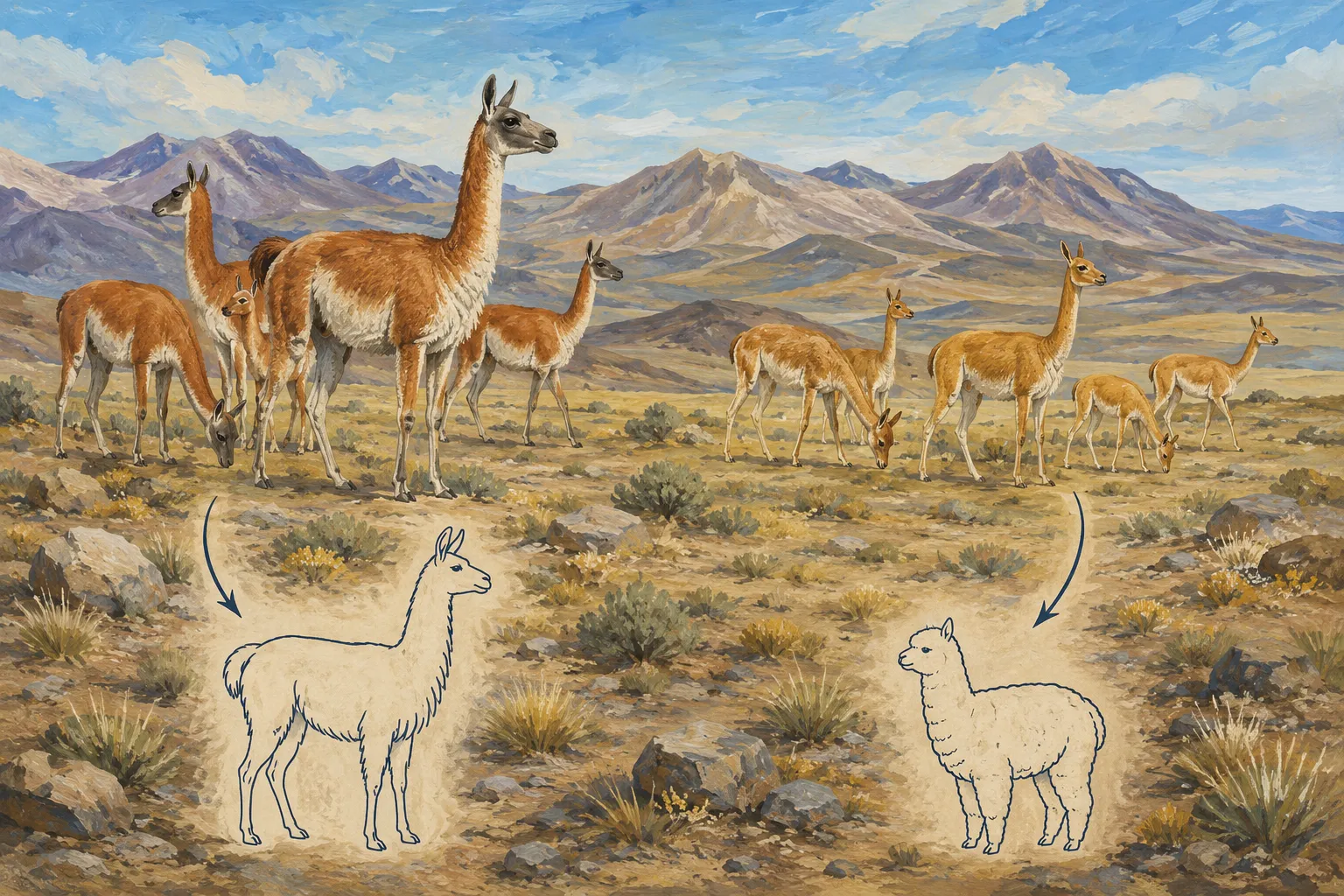
The deeper family history of both animals begins outside South America. Camelids first evolved in North America, and one branch later moved south as animals crossed into South America during the Great American Biotic Interchange. Over a very long span of time, those South American camelids developed into the wild lineages represented today by guanacos and vicuñas.
Those two wild animals are the key to understanding the later split. The llama is closely tied to the guanaco lineage. Alpacas are strongly associated with vicuñas, but their ancestry is not as neat as a simple one-arrow family tree: genetic and ancient-DNA studies show substantial mixing among South American camelids, especially in alpacas.
That matters because alpacas did not simply “come from llamas,” and llamas are not oversized alpacas. Their differences began with older wild populations and were then amplified when people in the Andes started managing and breeding camelids for different purposes thousands of years later.
The next part of the story is therefore not another evolutionary split. It is a human one: the gradual change from hunting wild camelids to managing herds and eventually raising recognizably domestic animals.
A human turning point
When did alpacas and llamas become domesticated?
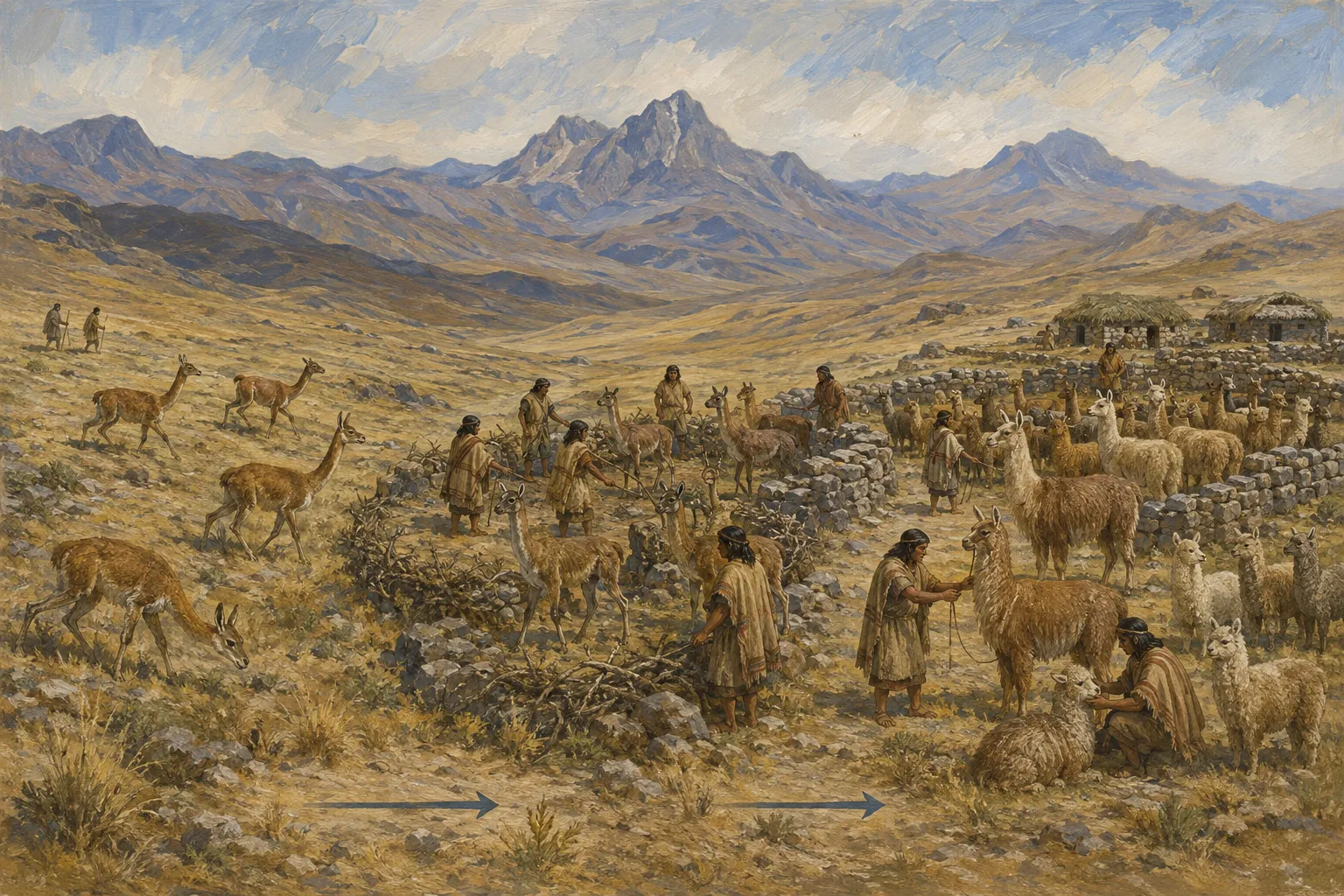
The change did not happen in one village or in a single generation. For thousands of years, people in the Andes hunted wild camelids for meat, hides, and fiber. Gradually, some communities began spending more time near the same herds and controlling where the animals moved rather than relying only on the hunt.
By roughly 6,000 years ago, the relationship had changed enough that recognizably domestic camelid populations were emerging. People could keep animals closer to settlements, protect useful herds, and influence which animals reproduced. That was the beginning of a very different relationship between humans and camelids.
Domestication therefore describes a process, not a moment. Wild animals became managed animals, and managed animals gradually became livestock whose survival and reproduction were increasingly tied to people. Over many generations, those choices began changing the animals themselves.
The result was not yet the sharply specialized alpaca and llama we know today. That came later, as Andean herders increasingly favored different traits in different herds — especially fine fleece in alpaca-type animals and greater size and utility in llama-type animals.
What changed?
From wild herd to domestic herd
Wild herds choose where they travel, feed, and reproduce. Humans hunt or observe them but do not control the herd.
Animals are gathered, guided, or kept near useful grazing areas. Human decisions begin affecting movement, survival, and which animals remain together.
Breeding happens under human management. Animals are kept for useful traits, and domestic populations gradually become physically and behaviorally different from their wild relatives.
Different jobs, different animals
Why did alpacas and llamas become so different?
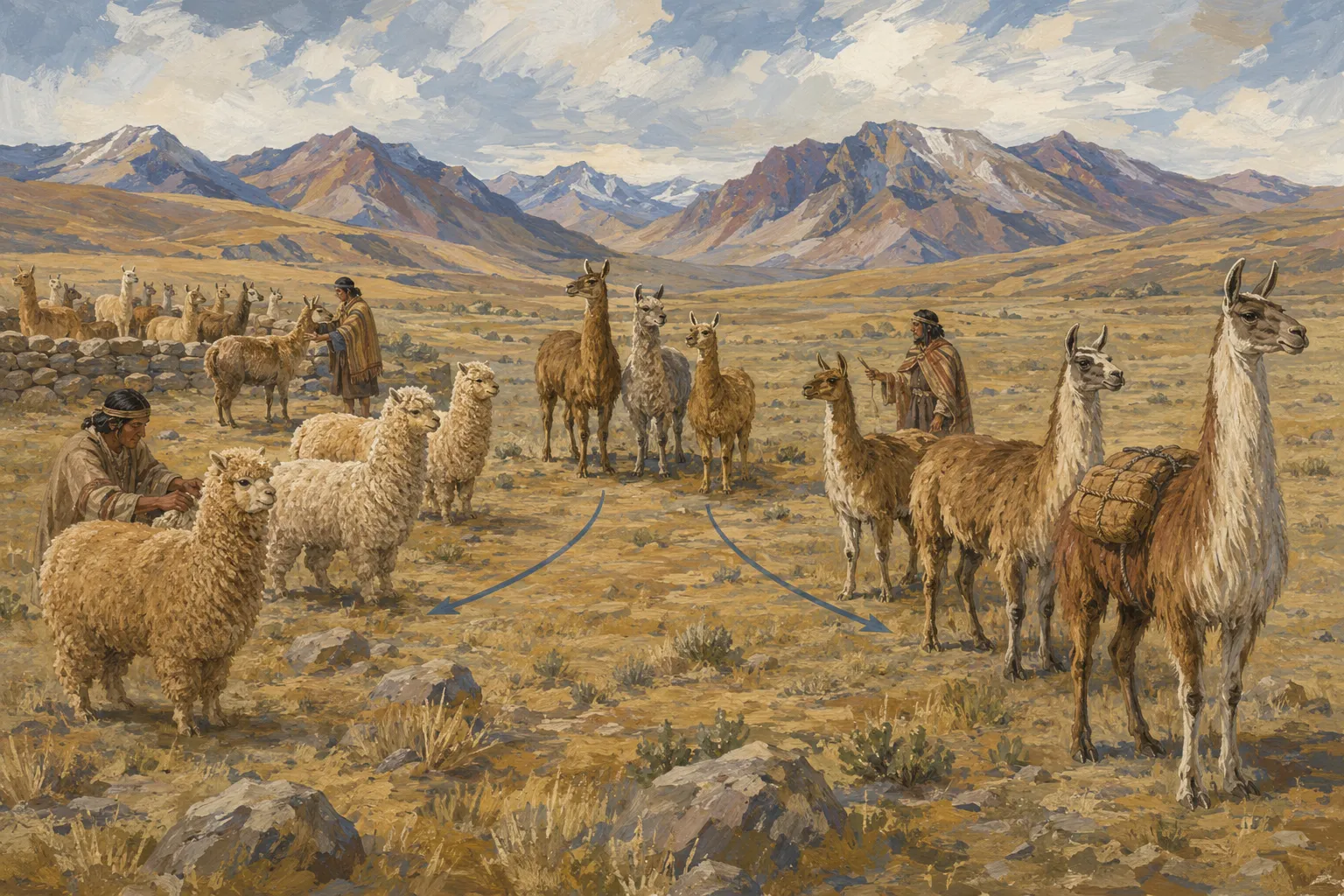
Domestication brought camelids under human management, but it did not freeze them in one form. Once Andean herders controlled breeding, they could keep animals that were especially useful and allow those traits to become more common over many generations. Different needs gradually pushed domestic camelids in different directions.
In alpaca-type herds, fiber became especially important. Animals with dense, useful fleece could contribute more material for spinning and weaving, so fleece characteristics became a powerful reason to keep and breed particular animals. Over time, that emphasis helped produce the compact, heavily fleeced animal associated with alpacas today.
Llama-type animals filled a broader working role. Larger body size and strength made them useful for carrying loads, while their meat, hides, dung, and fiber also had value. Selection did not create a llama overnight; repeated choices across generations favored a larger domestic camelid that could do work an alpaca was never expected to do.
This is one reason the modern differences go deeper than appearance. Size, coat, and historical use reflect long periods of human management layered onto older wild ancestry. The exact family history is complicated by later interbreeding, but the broad contrast between a fiber-specialized alpaca fiber-specialized alpaca and a larger multipurpose llama became one of the defining features of Andean pastoral life.
Change the trait
See what selection emphasized
Dense, useful fleece became a major reason to keep and breed particular animals, eventually making fiber production central to the alpaca's historical role.
Llamas also supplied fiber, yet their value was not centered on producing the same heavily specialized fleece.
Alpacas remained substantially smaller, a body plan that fit their role as herd-based fiber animals rather than pack animals.
Greater size and strength made llamas more useful for carrying loads and other demanding work in the Andes.
The alpaca's historical value became closely tied to the material growing on its body and the textiles that material could become.
Llamas became multipurpose livestock, especially important as pack animals while also supplying meat, hides, dung, and fiber.
Modern alpacas are strongly herd-oriented, but ancient behavior does not leave the same clear evidence as bones, body size, or fiber. It is safer not to treat temperament as a single deliberately selected trait.
Pack animals had to be managed and moved by people, but modern llama temperament reflects both biology and handling. The historical record cannot reduce that difference to one breeding choice.
Before the empire
Alpacas and llamas were ancient long before the Inca
The Inca are so closely associated with the Andes that it is easy to place alpacas and llamas inside their story from the beginning. But domesticated camelids were already part of Andean life for thousands of years before the Inca Empire appeared. Earlier communities had developed herding systems, managed grazing, and built everyday economies around these animals.
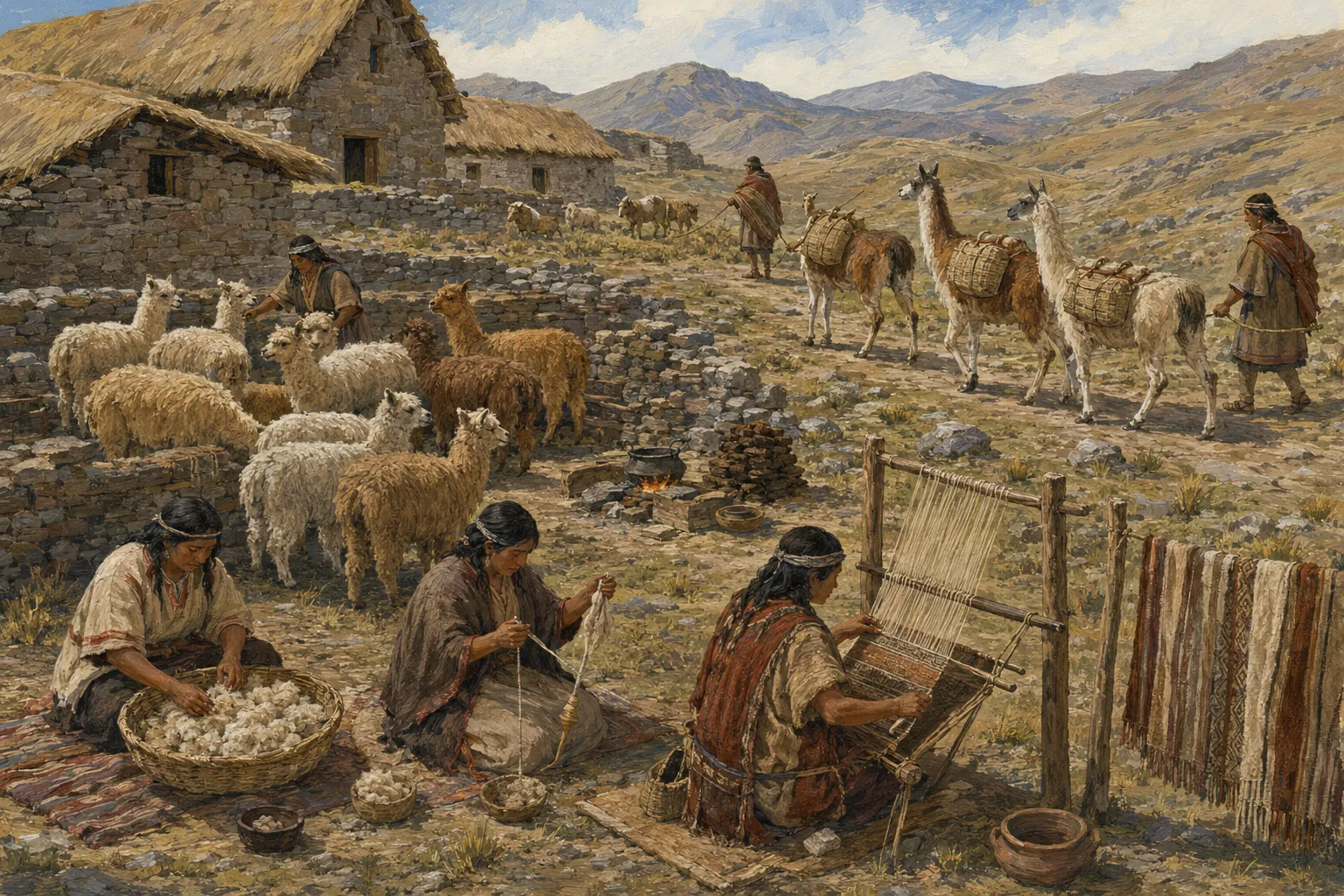
Camelids were useful because one herd could support several needs at once. Alpaca-type animals supplied valuable fiber for spinning and weaving. Larger llama-type animals could carry goods between settlements and ecological zones. Camelids also supplied food, hides, and dung that could be collected and used in highland communities where wood was limited.
That made camelids more than livestock standing beside a village. They linked households to clothing, movement, trade, food, and the difficult high-altitude environment itself. Llama caravans connected communities across long distances, while fiber production turned the animals grazing outside a settlement into material that could be spun, woven, exchanged, and worn.
So when the Inca later organized enormous herds and transportation networks, they were not inventing an alpaca-and-llama economy. They were expanding and reorganizing pastoral traditions that were already very old. That distinction matters: the history of these animals belongs to the Andes broadly, not to a single empire.
Life around the herd
What could camelids provide?
Camelid fleece could be spun and woven into clothing, bags, cords, and other useful textiles. Fiber gave a living herd value year after year.
Pack llamas allowed people to move commodities between communities and ecological zones across terrain where wheeled transport was not part of the system.
Domestic herds supplied meat as part of the broader pastoral economy. Their importance was not limited to fleece or transportation.
Dried camelid dung could be collected for fuel in treeless high-altitude environments and also returned nutrients to cultivated or grazing land.
The imperial scale
How the Inca organized alpacas and llamas
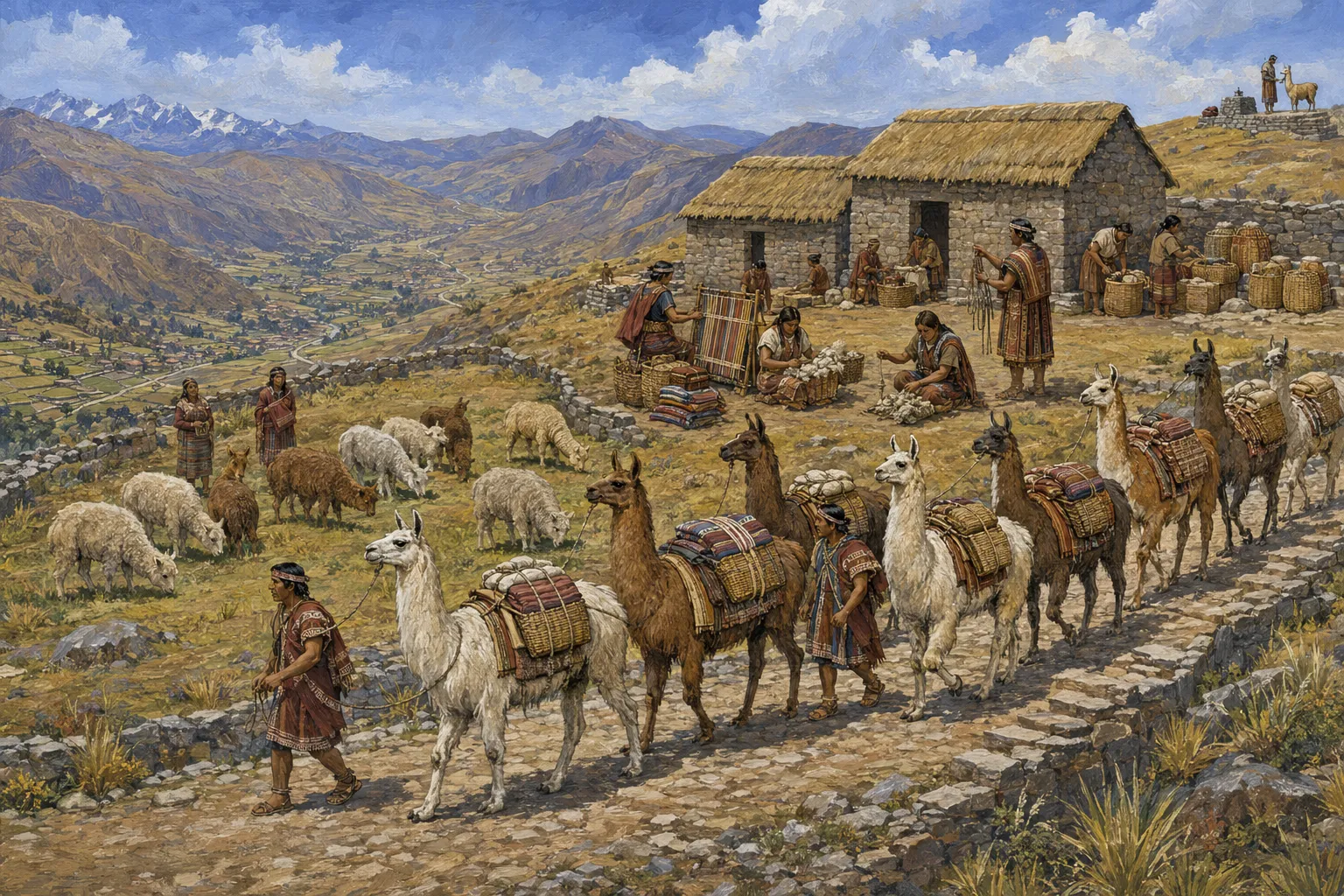
By the time the Inca Empire expanded across much of the Andes, alpacas and llamas were already ancient domestic animals. What changed was the scale of organization. The Inca incorporated camelid herds into a state economy that connected highland grazing lands with roads, storehouses, textile production, labor, and the movement of goods.
Llamas were especially important to that transportation system. Pack caravans could move food, raw materials, textiles, and other supplies across steep Andean terrain. They did not replace human porters, but they added a form of animal transport that could connect distant regions to administrative centers and storage facilities.
Fiber was another major resource. Alpacas, llamas, and wild vicuñas all contributed camelid fiber of different qualities to Andean textile traditions. Under Inca rule, textile production was tied not only to everyday clothing but also to labor obligations, redistribution, political relationships, and high-status goods. Herds themselves were therefore valuable resources, not simply collections of individual farm animals.
The important distinction is that the Inca did not create this relationship from scratch. Roads, caravans, herding, and camelid-fiber traditions all had deeper Andean histories. The empire expanded, reorganized, and connected systems that had existed long before it — turning alpacas and llamas into part of an economy that operated across an enormous geographic area.
Follow the caravan
How a llama connected the imperial system
Llamas suitable for transport could be gathered and organized with handlers before goods began moving across the highlands.
Loaded llamas moved along established Andean routes, carrying commodities through terrain where wheeled freight transport was not part of the system.
Inca storage facilities helped hold agricultural products and other resources. Llama caravans connected provincial production with these larger networks of collection and supply.
Food, raw materials, textiles, and other supplies could ultimately reach settlements, workers, armies, administrative centers, or the imperial heartland.