Alpaca History Peru
Alpacas in the Inca Empire
How a fleece from the high Andes became cloth to wear, trade or give away.
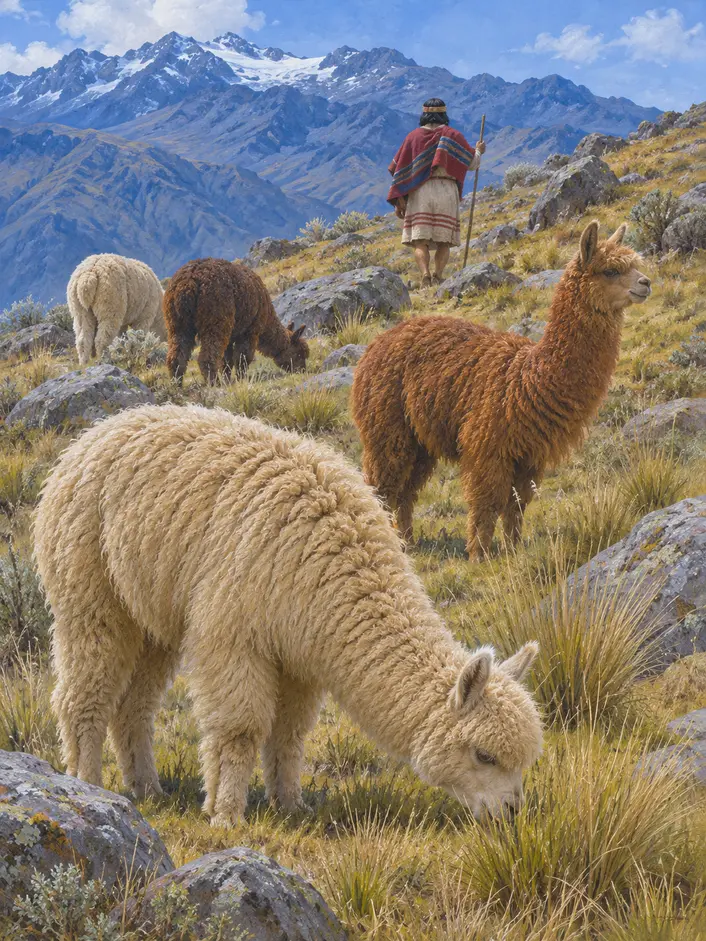
On a high Andean slope, the pale and dark backs of an alpaca herd stand out against the grass. Each of those coats grows back after shearing. A herder can harvest fleece and keep the same animal for another season, but a fresh fleece still holds short and long fibers, fine strands and coarse ones. To make a thread strong enough for weaving, someone has to separate those fibers, draw them out and give them twist.
When the Inca Empire expanded from Cusco in the fifteenth century, Andean communities already knew how to raise camelids and make sophisticated textiles. At El Yaral in southern Peru, preserved animals from before the imperial period retained coats that researchers could measure. The fleece evidence in Andean Origins takes that story back before the empire. People could turn a coat into something to wear in their own community, while the state drew on established skills to commission cloth it could give to a leader or use in ceremony. Wheeler on El Yaral The Met
The harvest that grew back
The high grasslands of the Andes are often called the puna. A single hillside can offer dry bunchgrass above and greener forage in a wet hollow below. Cold nights and the dry season make access to dependable pasture valuable. Alpacas can graze at these elevations, and their coats insulate them through cold weather. Herders still have to decide where the animals should feed, when to move them and when to bring them together. Research among alpaca herders in the Bolivian Andes records the importance of wet meadows called bofedales during dry periods. The study describes recent herding and helps explain why access to particular patches of land matters. Buttolph and Coppock
When the animals were gathered for shearing, the work shifted from watching a dispersed herd to handling one animal at a time. A fleece could yield fibers of different lengths and thicknesses. Keeping the more even portions together at this point gave the spinner a better chance of making an even thread later. Herds also had uses beyond textiles. Llamas could carry loads between settlements, and camelid dung could serve as fuel. In farming communities with access to both cropland and pasture, tending animals and growing crops drew on the same pool of household labor. Which work took priority depended on local land and season. The attraction of a fleece harvest was that it left the animal in the herd to grow another coat. Over time, which animals herders kept and bred could shape the supply of fiber just as surely as how they sorted the harvest.
Animal bones give archaeologists a way to ask where herds fed. In the southern Nasca region of Peru, researchers compared chemical traces in bones from sites occupied before the Inca Empire. Some animals appear to have eaten cultivated plants, and others had diets consistent with grazing or feeding in coastal environments. Herders in this part of Peru had already developed several ways of feeding and keeping camelids. Bone chemistry can show that an animal probably fed in a particular kind of landscape. The daily route, the timing of a roundup and the identity of the person who did the shearing remain outside what those measurements can recover. An imperial demand for cloth could reach into this work through demands on labor and supplies, while families continued raising animals for uses of their own. Southern Nasca isotope study
Making a thread by hand
Begin with a handful of fleece. Pull away plant matter and separate coarse strands from the fibers chosen for a fine yarn. Open the clumps with your fingers until you can draw out a narrow supply of fiber. The fibers overlap like a row of short sticks laid end to end with their ends crossing. The spinner needs enough overlap that the next pinch of fleece joins the thread already forming. One hand holds the supply. The other controls how much of it feeds into the moving yarn.
Look at the thin line between the raised hand and the hanging spindle in the illustration. The pale mass wound around the spindle is yarn already made. In use, turning the shaft sends twist up the line into the drawn fibers. A small weight called a whorl helps the spindle keep rotating. Museo Larco in Lima displays ancient Peruvian examples of this weight, also called a piruro, alongside other textile tools. When enough yarn has formed, the spinner winds it onto the shaft and sets the spindle going again. One thread can also be twisted together with another to make a plied yarn. That is a separate action from putting the first twist into loose fleece, and it gives the yarn maker another way to control the thread. The illustration shows one way to picture that work. The museum tools are the surviving evidence. Museo Larco
A spinner can feel a thick spot where too much fleece has entered the thread, or a thin spot where a small pull might break it. Drawing at a steady rate and controlling the twist makes the thread more predictable. That matters when the weaver stretches the lengthwise threads under tension. A break means stopping to mend one line before weaving can continue. Similar thickness also makes neighboring bands of color sit more evenly. Pale and dark coats supplied useful colors on their own. Dyes extended that range. The Met identifies cochineal, a red colorant obtained from insects, among the materials used in Andean textiles. The red bands on a photographed tunic alone give no basis for identifying a specific dye. The Met

- Draft
- Draw overlapping fibers into a thinner strand.
- Twist
- Turn the spindle so the fibers hold together.
- Wind
- Wrap the finished length around the shaft.
The loom works under tension
In the weaving illustration, parallel threads run between two bars. These are the warp, the threads set up along the length of the cloth before weaving begins. On a backstrap loom the far end is tied to an anchor, and the near end is attached to a strap around the weaver’s body. Leaning back puts the threads under tension. Easing forward lets the weaver relax them to make an adjustment. The arrangement gives the person sitting at the loom direct control over how taut the threads are. Backstrap and fixed horizontal looms both appear in Museo Larco’s account of ancient Peruvian textile technology. Museo Larco

The weaver lifts one group of warp threads away from the others, making a narrow opening. A crosswise thread, the weft, goes through it. Then the weaver changes which threads sit above the opening and passes the weft back. A flat tool called a batten pushes each pass snugly against the previous one. In the illustration, red and blue threads extend from the woven area into the loose warp. That setup helps explain how a lengthwise stripe can begin with a choice about where to place colored threads before the first pass. In tapestry weaving, by contrast, packed colored wefts can cover the warp and make the visible design. Packing the weft changes what the eye sees even when the warp underneath is one color. The visible pattern, then, tells a reader where to look, while a close study of the threads tells a conservator how it was made.
Andean households already had reasons to weave before Inca officials could call on that skill. Clothing wears out, and a household that makes a carrying cloth gains a tool for other work. Imperial production also called for specialists. The Met describes women and men making fine textiles at central weaving establishments and provincial sites. Dumbarton Oaks records the work of the acllacuna, women in state institutions who produced cloth for royal and religious use. Its term qompi refers to fine cloth made by specialists. These forms of work could exist alongside local production. Gathering unusually fine yarn, assigning experienced weavers and setting a standard for the cloth were all ways the state could get garments suitable for a particular occasion. The Met Dumbarton Oaks
Look closely at the tunic
Peru, 1400–1530 The Metropolitan Museum of Art
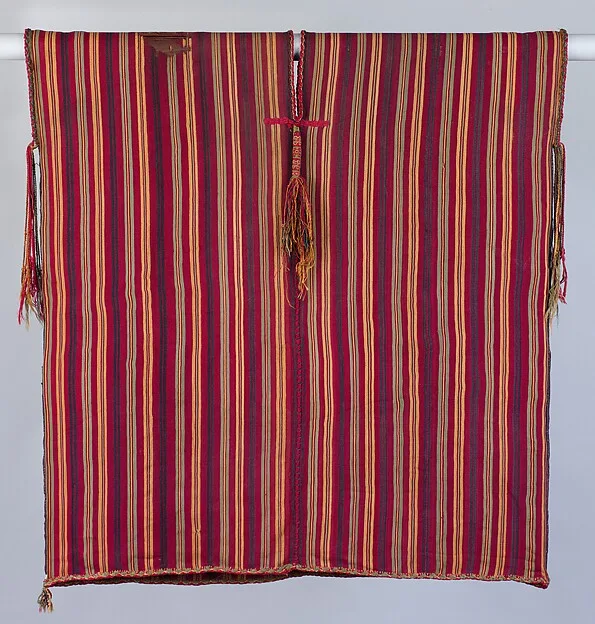
From a distance the tunic looks almost rectangular. Then the slit at the top comes into view. It makes an opening for the head without the scooped neckline familiar from many modern shirts. A short red tie crosses the opening and cords hang down the middle. Openings at the upper sides allow the arms to emerge. Below them, the sides and lower edge define a broad garment that would hang from the shoulders. The Met gives its height as 83.8 centimeters from top to bottom.
The most conspicuous colors are the wide red bands. Look closer and the pattern breaks into groups: thin gold or cream lines run beside dark stripes, and those groups repeat across the face. Near the lower edge, the vertical rhythm stops at a narrow horizontal finish. The closer view shows slight irregularities in the edge and a loose bundle at the left corner. The photograph lets us compare the placement of these features. Questions about the order of assembly or later alterations would call for examining the fabric itself.
Another Inca garment shows what such an examination can establish. Dumbarton Oaks describes its All T’oqapu Tunic, dated 1450–1540, as a long rectangle woven with a neck slit, folded over and sewn along the sides up to the arm openings. Its analysis identifies undyed cotton warp and dyed camelid weft. Where the striped Met garment repeats narrow bands, the Dumbarton Oaks tunic is covered with small geometric units. The museum interprets that concentration of designs as a possible expression of royal authority. That interpretation concerns the garment as a whole, and the individual motifs resist a secure reading as a set of names. Dumbarton Oaks
For the striped tunic, The Met’s record establishes a Peruvian Inca attribution, a date range and the fiber category. The photograph brings the proportions and finishing into view. Trace one narrow pale stripe downward, then find the same group farther across. The eye can follow that order even where the surface buckles or a cord crosses it. Its maker, wearer and route into use remain open questions. The Met object record
What a gift of cloth could buy
A household could keep cloth in use for years by wearing it, mending an edge or putting it to work as a wrap. A state official could put a fine garment to a different use by giving it away. Both uses depended on the same practical fact: a piece of cloth gathered up a great deal of work in something a person could wear, fold or carry. The finished piece could travel between households or be handed to someone who had never seen the herd, the spinner or the loom.

Evidence from Huánuco Pampa
Colonial writers recorded practices after conquest, often through officials and people describing a changed political world. Archaeological evidence answers other parts of the question. At Huánuco Pampa, in central Peru, excavators documented large storage facilities at an Inca administrative center. Those buildings demonstrate the capacity to gather and hold supplies at a provincial site. They give physical context for a state that assembled goods on a large scale. The route taken by the striped tunic remains unknown, so its value as evidence lies in the garment itself. A storeroom belongs to the story because supplies for obligations and gatherings had to be ready when people arrived. A gift given in person could be the last step in an operation that had begun months earlier with a fleece or a request for finished cloth. Huánuco Pampa excavations
From woven tunic to knitted jumper
Run your fingers along the ribbing on a modern alpaca jumper and you can feel the rows of loops. The ribs form alternating raised and recessed columns. Pull across them and the ribbing opens a little, then draws in when released. That stretch comes largely from knitting: a strand passes through loops that have room to change shape. In the woven tunic, the long and crosswise threads intersect more tightly. Its broad cut and openings make room for the body. The shape of the tunic leaves room through the body, while the ribbing on a jumper can hold a cuff close to the wrist.
How a finished garment feels also starts well before it is woven or knitted. Sorting changes the mix of soft and coarse fibers in the yarn. Twist changes how tightly the fibers hold together. A fairly open knit and a firmly packed weave made with similar fiber can handle very differently. In modern alpaca clothing, the fiber label gives you one piece of information. The surface, thickness and construction explain much of what you feel when you lift or stretch the garment. A ribbed alpaca jumper makes that easy to see at the cuff, where the same yarn can behave differently from the knit across the body.
| Feature | Woven tunic | Knitted jumper |
|---|---|---|
| Threads | Lengthwise and crosswise threads interlace. | Loops link into rows. |
| Fit | A broad cut leaves room to move. | Ribbing stretches across its columns. |
| Look for | The straight sides and neck slit. | The ribs at a cuff or hem. |
The finished tunic makes the weaver’s decisions visible, but the cloth began with decisions about animals and pasture. Andean Origins follows the earlier relationship between herders and camelids. The Alpaca History hub follows the story beyond the Inca period.
Sources and objects
- Museum objectThe Met · Striped Inca tunicAccession 2005.288, dimensions, material and public-domain photograph.
- Museum objectDumbarton Oaks · All T’oqapu TunicAccession PC.B.518, cotton warp, camelid weft and evidence of construction.
- Archaeology · open PDFWheeler, Russel & Redden · El YaralOriginal fleece measurements from preserved pre-conquest alpacas and llamas.
- Archaeology · open PDFUCLA · The South American CamelidsThe archaeological synthesis puts the El Yaral fiber samples in regional context.
- Museum essayJulia McHugh · Andean TextilesDyes, specialist weaving and the evidence for checkerboard garments.
- Museum toolsMuseo Larco · Textile TechnologySpindle weights, loom types, battens and how the tools were used.
- Art historySarahh Scher · All-T’oqapu TunicHow fine garments could mark rank or secure obligations to the state.
- Archaeology · open PDFEerkens and colleagues · Southern NascaBone chemistry and evidence for diverse camelid feeding practices.
- Field researchButtolph & Coppock · Bolivian grazingWhy highland herders rely on wet meadows during dry periods.
- Excavation abstractMorris & Thompson · Huánuco ViejoThe excavated administrative center and its extensive storage facilities.