The Andes in the 1500s and 1600s
Alpacas in the Spanish Colonial Period
After the Spanish conquest, Andean herders still had animals to feed, and weavers still needed yarn. What changed was who could claim the fleece, the cloth, and the time it took to make it.
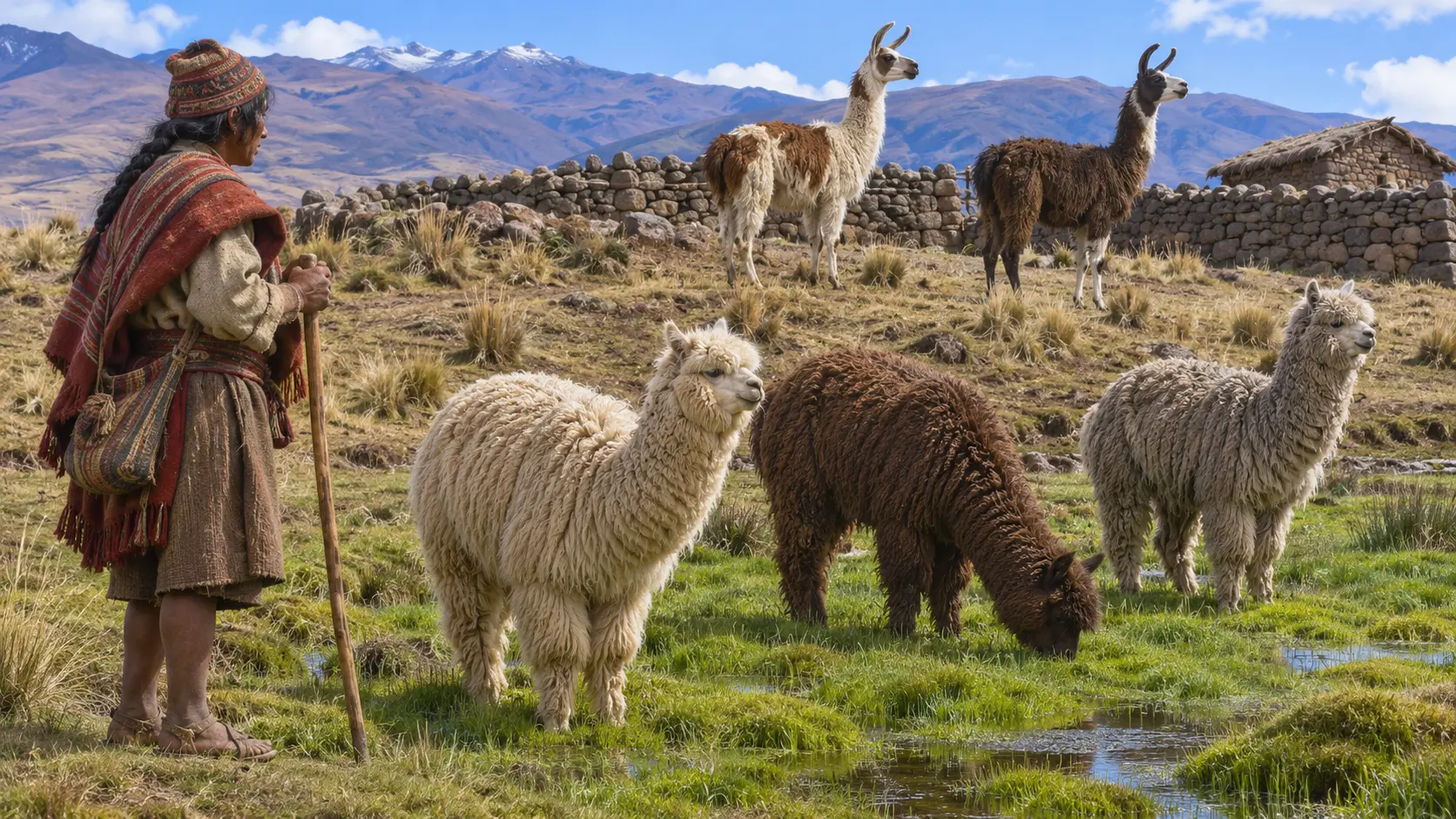
Cajamarca, 1532
Who could claim the fleece?
Imagine finishing a length of cloth and having to hand it over. In the Inca Empire, rulers could call on communities for goods and labor. When Spanish forces captured Atahualpa at Cajamarca in 1532, the upheaval that followed broke up that imperial system. The people who knew how to find fresh pasture, shear an alpaca, or turn a handful of fleece into yarn were still there. Their skills made the new colonial enterprises possible.
Consider the Oré family’s textile workshop at Chincheros in present-day Ayacucho, Peru. Historian Miriam Salas Olivari follows the operation beyond the workshop doors, into the settlements that supplied it. Even a wooden shaft for a finishing mill depended on people finding the right timber and bringing it back. Fiber and tools could come from different places. Before a bolt of cloth reached a buyer, it already contained work done well away from the loom.
The examples here follow the first century and a half or so of Spanish rule in the central Andes, from highland Peru and Bolivia to a Pacific port in present-day Chile. The colonial period continued into the nineteenth century.
For a household, the terms mattered as much as the amount owed. Supplying an animal meant giving up stock that could provide another year’s fleece. Supplying finished cloth meant finding fiber and spending time spinning and weaving it. The two demands drew on different parts of the same local economy.
Did alpacas and llamas graze together?
They can, and modern surveys document holdings that include both. The colonial records tell us more about who owned animals and which ones carried loads than about the makeup of a grazing group on any given day.
One owner, several pastures
Antonio de Oré held an encomienda in the Huamanga region, which entitled him to tribute from a designated Indigenous population. His estates had sheep, goats, camelids, and horses. Some of his animals went to pasture at Cayara. A stock list that covers his holdings can bring several kinds of animals together on one sheet of paper even when their herders work miles apart. In this case, the camelids were recorded as a category, so the list gives us neither a count of alpacas nor a picture of what grazed at Cayara on a particular day.
What happens when the grass dries out?
On the puna, the high Andean grassland, a wet meadow can stay green after drier ground has lost much of its forage. Herders in Bolivia’s Cordillera Real still rely on these wet places, called bofedales, during the dry season. A modern Peruvian survey also shows how varied mixed livestock holdings can be. Those studies make clear why access to pasture and water can change which animals graze where. To describe a colonial herd’s movements, we would still need evidence from that place and time.
A meadow also gives herders a reason to distinguish where animals belong from where they are today. Two households may use the same wet ground when feed is scarce and keep their animals apart at other times. A description written in the dry season tells a different story from an inventory made at a corral.
Fleece, breeding, and a load for the road
A herder could gather animals to shear them, separate them for breeding, or choose a group for a trip. Those jobs called for different decisions. The fiber from alpacas was valuable for cloth, and people also worked llama fiber. For a long journey with goods, a handler needed llamas that could carry a burden and keep up with a group. The handlers needed their own knowledge of the way, including where to get water and where the animals could feed overnight. A caravan could leave with just the animals suited for that trip while other stock stayed at home.
Pacific coast to the Bolivian highlands
The road from Cobija to Potosí
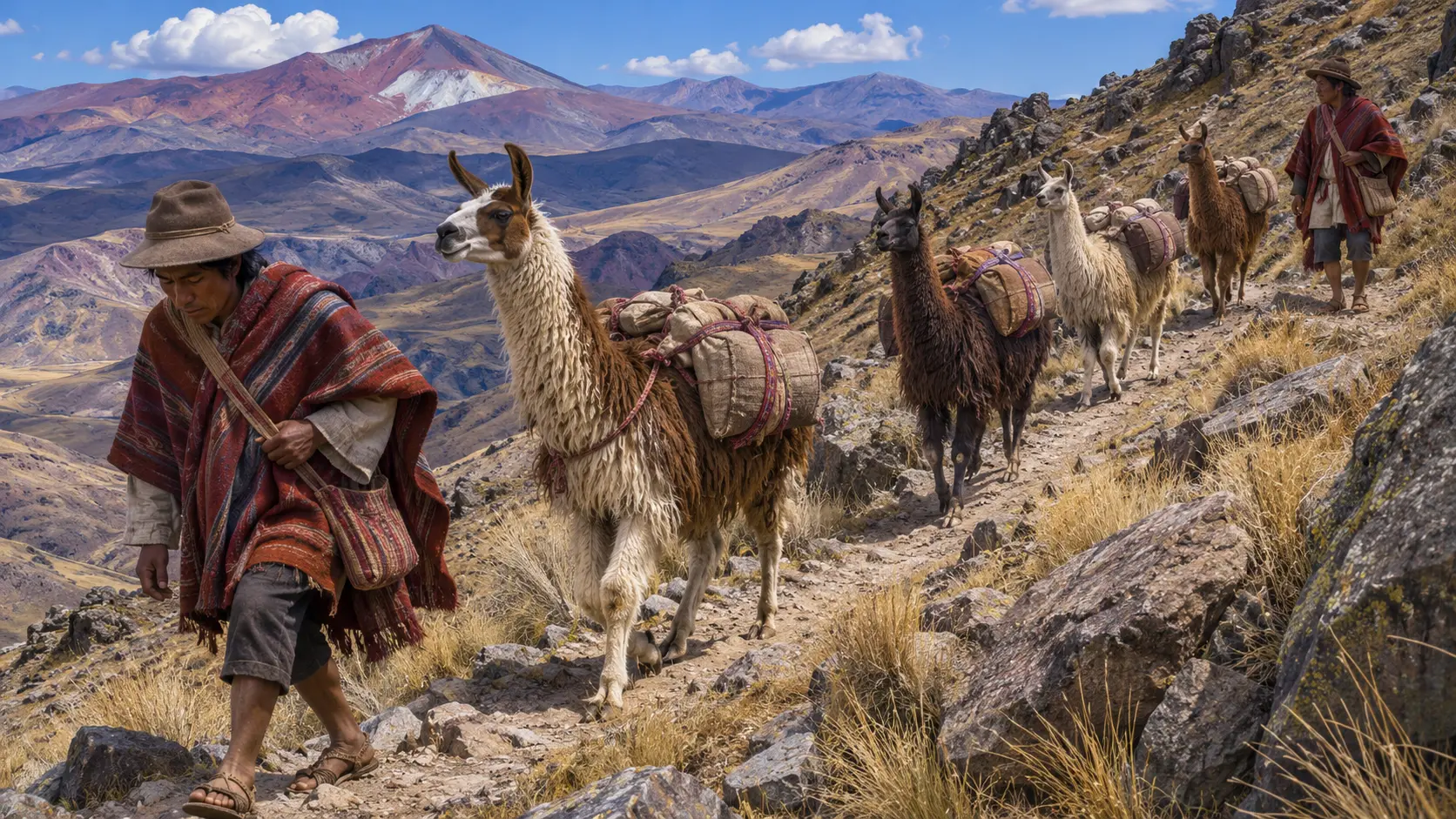
Dried fish for a silver town
At Cobija, on the Pacific coast of what is now Chile, dried fish was one of the goods headed inland. It could travel through the Atacama toward Potosí, Porco, or La Plata. Silver production began at Potosí in 1545, and the mining town became a market for goods from far beyond the highlands. To get there, people had to plan each day’s walk around the next place with water, forage, and somewhere to stop.
Archaeologist Francisco García-Albarido follows the traffic through written accounts and evidence left along the route. Indigenous porters carried fish on foot in the early colonial decades, some of it demanded as tribute. By the late sixteenth century, complaints show that human carrying continued despite prohibitions. Llama trains also sustained traffic. Porters and animals could have worked on overlapping stretches of the road.
Who arranged the trip?
Merchants and officials made arrangements through Indigenous leaders, or curacas. Specialist llama handlers brought their own expertise, pack animals, and carrying gear. It mattered how a load sat on the animal and how far it could go before stopping. Mules later took on more of the trade, opening up choices about routes and stopping places even where the destinations stayed the same.
A cargo delivered as tribute, a transport service bought by a merchant, and a compulsory labor assignment could all move goods along the same route. García-Albarido describes a rotating labor draft, or mita, for roadside stations and transport. Its rules required payment. Potosí also had a mining mita with its own arrangements. A recorded wage tells us something about compensation. It leaves open whether the worker could refuse the job.
The records also put officials and Indigenous leaders on the business side of the route. A leader arranging a shipment and a porter carrying it could both appear under the broad heading of transport, though they stood to gain different things and had different power to set the terms. Knowing who made the bargain helps explain whose work a delivery depended on.
Fish appears by name in accounts of the Cobija route. For a documented fiber transaction, turn back to Huamanga. Workshop operators sent carriers into the highlands with grain to trade for fiber. The outbound cargo and the expected return tell us what both sides had to offer.
García-Albarido’s route studyPotosí mining labor study (PDF)
From fleece to clothing
Try to pull a handful of fleece into a long strand. Without twist, it falls apart. A spindle feeds twist into the fibers as the spinner draws them out. How much fiber the spinner lets through at once helps determine the thickness of the yarn.
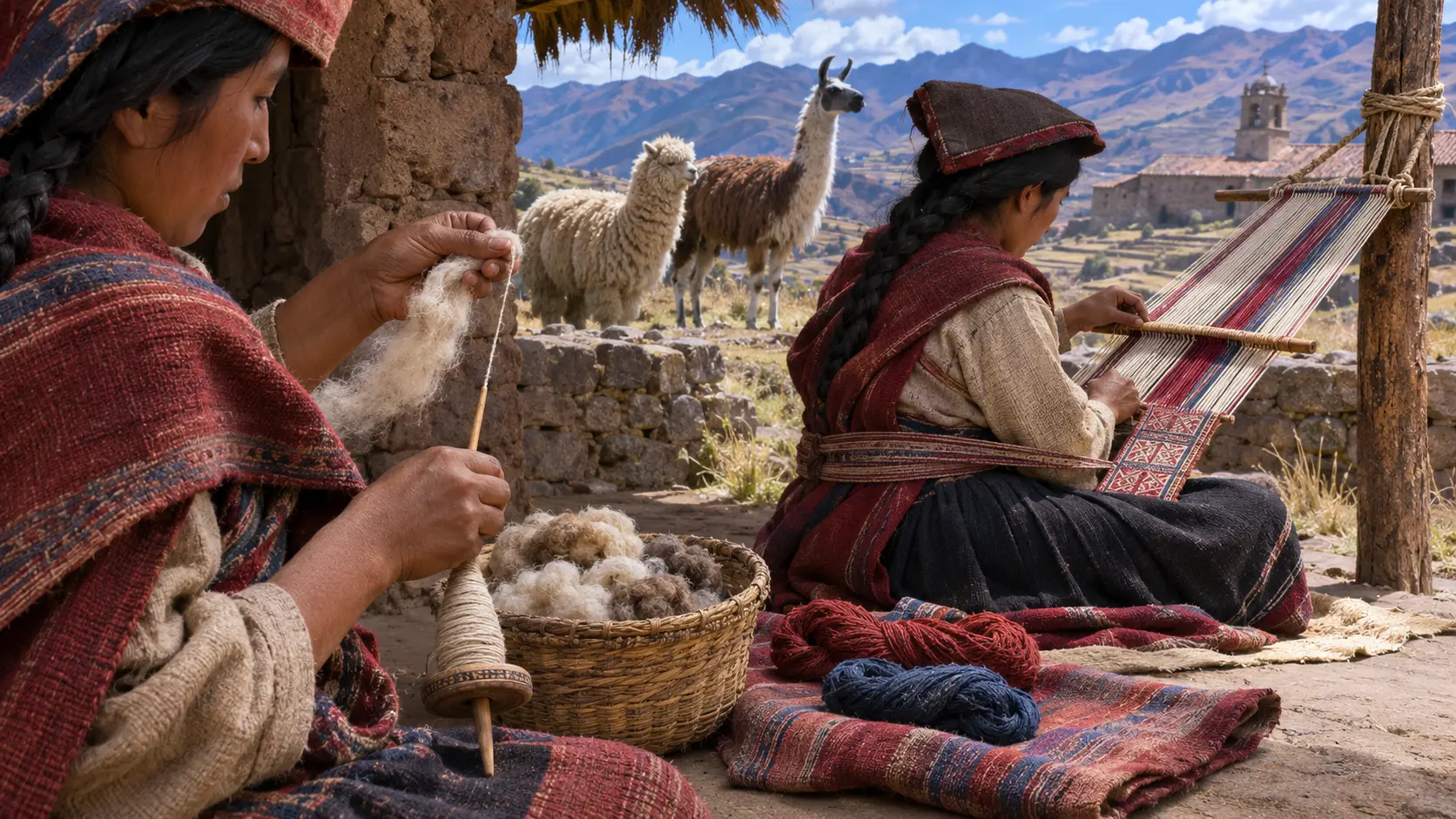
Working the backstrap loom
- Set the warp. Anchor the lengthwise threads at one end and attach the other end to a strap around the body.
- Pass the weft. Lean to adjust the tension, lift selected warp threads, and pass yarn across the opening.
- Pack the row. Press the new yarn into place. In tapestry, packed rows of weft can cover the warp and carry the pattern.
At the spindle
Sorting starts before the spindle turns. Longer and shorter fibers behave differently when drawn out, so grouping similar locks makes it easier to control the strand. Preparation opens the locks and removes debris. A spinner can then twist two or more finished strands together to make a plied yarn.
Natural fleece colors give a weaver one way to build a pattern. Dyeing widens the choices. Once the warp is set, each patch of color has to end where the design calls for the next one to begin. The weaver has to keep the edge even as the work moves forward, row by row. On a backstrap loom, adjusting the pressure of the body is part of that work.
The yarn also has to suit its place in the cloth. Warp threads stay stretched and rub against one another as the weaver opens a path for the weft. A snag or a break there can interrupt the whole row. The person spinning therefore has to think ahead to how that strand will behave on the loom.
Inside an obraje
A colonial textile workshop could divide the work across many hands. Salas Olivari describes treadle looms, which let a weaver move parts of the warp by pressing pedals, and mills for fulling, a finishing process that compacts woolen cloth. Indigenous artisans made and repaired equipment, including tools introduced from Spain.
Owners wanted cloth they could sell in towns and mining markets. In late-sixteenth-century Huaraz, one owner made coarse woolen cloth at his workshop and kept a large flock of sheep. Other early textiles used camelid fiber. The word lana, meaning wool, in an account is a reason to check what else the record says about the material and where it came from.
Households could draw on the same people for herding, spinning, and other work. Workshop inspectors sometimes listed men and boys as spinners and mentioned relatives who helped. A list of looms and assigned workers could still miss part of the labor that went into meeting a workshop’s quota.
Fulling adds another step after weaving. A workshop that finishes its cloth needs a place to do the work, equipment, and people who know how far to take it. That helps explain why records about manufacturing mention wood, mills, and workers who may never have sat at a loom. The cloth market drew on all of them.
Read a wedding mantle thread by thread
The Met’s Peruvian wedding mantle, object 08.108.10, is a lliclla, a shoulder covering dated to the late 1500s or early 1600s. Look for small geometric panels called tocapu alongside a Spanish-style lattice. Zoom in on a boundary between two colors. That line was made in the weave, with the worker placing each color where it belonged.
The catalogue lists cotton along the length and camelid fiber across the cloth. Those threads do different jobs in the same garment. The cotton supports the weave. The crosswise yarn packs down to form the patterned surface. The alpaca clothing guide takes that practical question into the present, where the way a garment is made still shapes how it feels and wears.
The interlace and the square panels can be read at two distances. From across a room, the eye follows the larger pattern. Close up, the weave shows how carefully the worker held those outlines. Both views help explain how a design could carry different visual traditions while being made as one piece of cloth.
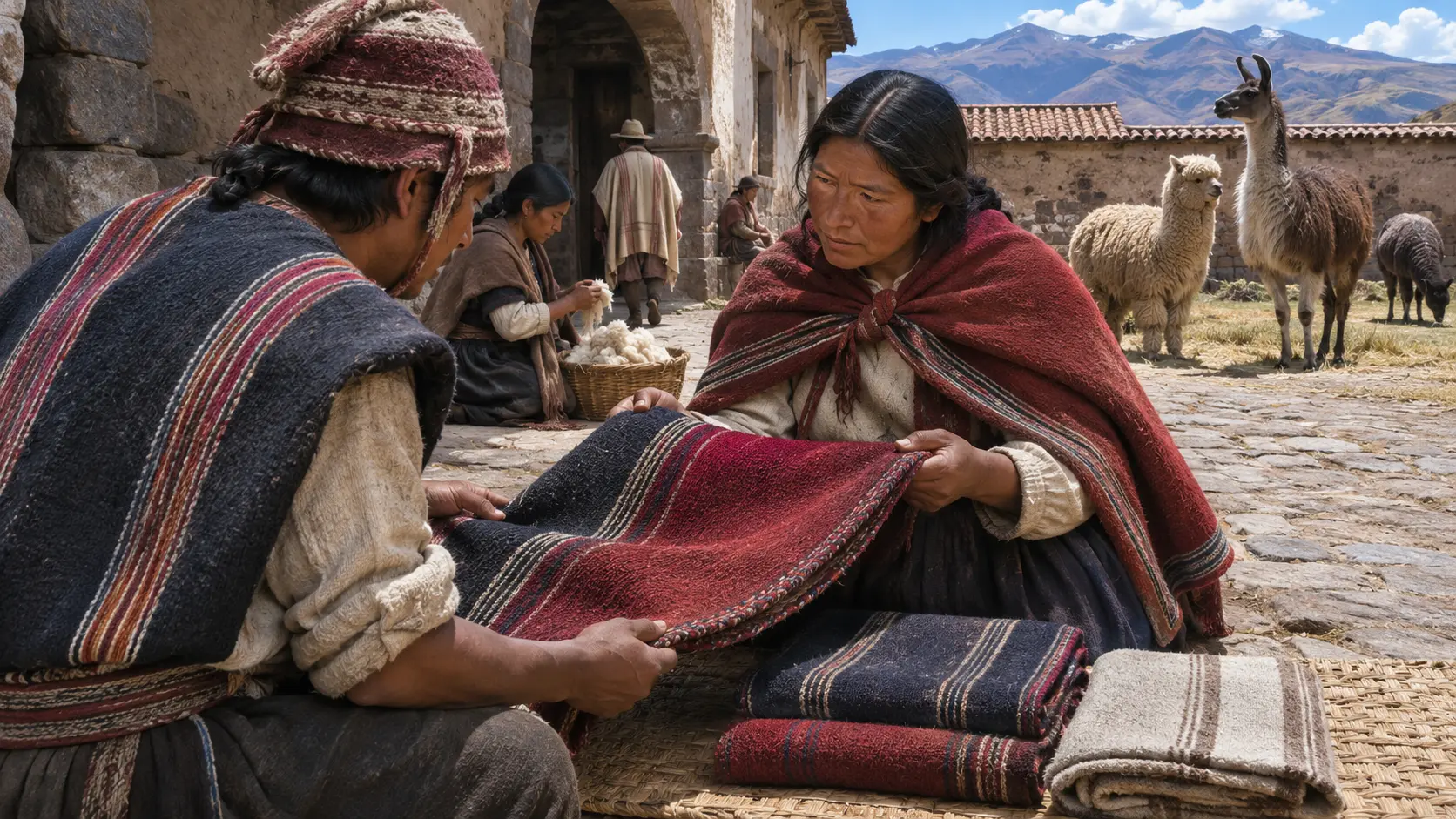
Who did the work?
Felipe Guaman Poma de Ayala was an Indigenous Andean writer from the Huamanga region. Around 1615 he made spinning part of his illustrated account for the Spanish king Philip III. Look at the hands in the drawing. One holds the supply of fiber, the other controls the strand as the spindle hangs below. The picture makes an everyday skill visible and shows the role he gave it in his account of Andean society.
The workshop lists ask a different question. They can tell us who was assigned to spin, dye, or supply firewood. They cannot tell us everything about how people learned those skills or when relatives lent a hand. A catalogue, meanwhile, can name the thread that survived while leaving the person who spun it unknown.
Open a record to see what it reveals.
A chronicle
Page 225 of Guaman Poma’s manuscript shows a woman spinning. He grouped women’s work by age to make a point about responsibility and skill. The drawing shows how he represented the task. It leaves the species of fiber and the frequency of the work open.
See manuscript page 225About the chronicle at the Royal Danish Library
A surviving garment
The mantle preserves a weaver’s choices about structure, pattern, and materials. The museum record identifies the yarn in each direction. It leaves the maker’s name and the origin of the camelid fiber open.
A workshop labor table
Look for the dyers, spinners, and people who supplied firewood in Salas Olivari’s table. Each job helped make cloth possible. A head count by task leaves open who chose the work, who could refuse it, and how much time relatives spent helping.
Questions the records leave open
Did every colonial mantle use alpaca?
Two shoulder mantles can share a name and have quite different fibers. Even within one piece, the body, edge, and fringe may use different materials. Begin with the individual object’s catalogue entry and pay attention to exactly which part of the cloth each material describes. The Met’s mantle gives us the family of animal that supplied the weft, while the species and the maker’s name remain open questions.
Did sheep displace alpacas?
Sheep supplied a growing workshop trade. To see what happened to alpacas in the same area, we would need records that distinguish the two animals and cover the same district over time. A larger sheep inventory alone can tell us how many sheep were counted. It may tell us very little about whether alpaca herders lost access to a meadow or kept their animals on different ground.
Can we tell who wore the mantle?
The catalogue’s title identifies it as a wedding mantle. That gives a reader a way to think about dress for an occasion. A name for the garment and a date range cannot identify its first wearer. For that, we would need evidence connecting this particular piece of cloth to a person or household.
How much work went into one piece?
An inspector could count looms in a workshop. Counting hours would mean following people beyond the loom, from sorting and preparing yarn to finishing the woven cloth. The Huamanga example also takes us beyond the workshop, to the people who provided fiber and even timber. How much labor we can see depends on where the record starts.
In Vilcashuamán, carriers headed uphill with grain and came back with fiber. They were using an established way of exchanging the products of warmer valleys and colder pastures. A colonial workshop gave the fiber a new destination, and its owners a claim on the cloth that came off the loom.
Researchers and collections
- Miriam Salas Olivari · Peru’s National Academy of History
- Peru’s National Academy of History lists her publications on colonial textile work and Indigenous labor.
- Nicholas Tripcevich · UC Berkeley
- The UC Berkeley archaeologist studies Andean caravans and long-distance exchange.
- Weaving Lives Museum · Cusco
- The Cusco museum follows the work from spinning and dyeing to the backstrap loom.
- Weaving an Empire · The Textile Museum
- The Textile Museum’s exhibition introduces Inca-era clothing and regional styles that preceded colonial production.